How to Tell Real Kobe Beef (and Eat It) on a Kobe Day Trip
Kobe is a short train ride from Osaka and most people only come for one reason. Fair enough, but the beef is better as the end of a day than the whole of it, and the city between the mountains and the harbour is walkable in an afternoon. Here's the day, ending at the table.
How to tell real Kobe beef
"Kobe beef" is one of the most misused food names in the world, and a lot of what's sold under that name outside Japan, and some inside, isn't. Real Kobe beef is a strict designation, and there are a few things to check.
Certified restaurants and butchers display a small bronze cow statue or plaque at the entrance, a mark of certification from the regional beef promotion association. No mark, treat the claim with caution.
Every certified animal has an individual ID, and certified restaurants can show the certificate for the cattle they're serving; good ones display it at the counter.
The definition itself is narrow: Kobe beef is Tajima-breed cattle, born, raised and slaughtered in Hyogo Prefecture, graded highly with strict marbling standards. Only a limited number of animals qualify each year. If a menu says "Kobe-style" or "Wagyu from Kobe," that's not the same thing.
Price is a signal too. Real Kobe sirloin runs from a substantial sum for a modest dinner course to considerably more at well-known counters. A cut-price "Kobe beef lunch" is either a small portion of a lesser cut or not Kobe at all. Lunch courses at certified places do exist and are the value play.
Book ahead for dinner; the well-known teppanyaki counters fill days in advance.
Getting to Kobe from Osaka
A JR rapid train from Osaka station to Sannomiya takes about 20 to 25 minutes. Hankyu or Hanshin lines from Umeda are a little slower and cheaper. Sannomiya is the centre; everything below is within a walk or a short train ride.
Port Tower and the harbour
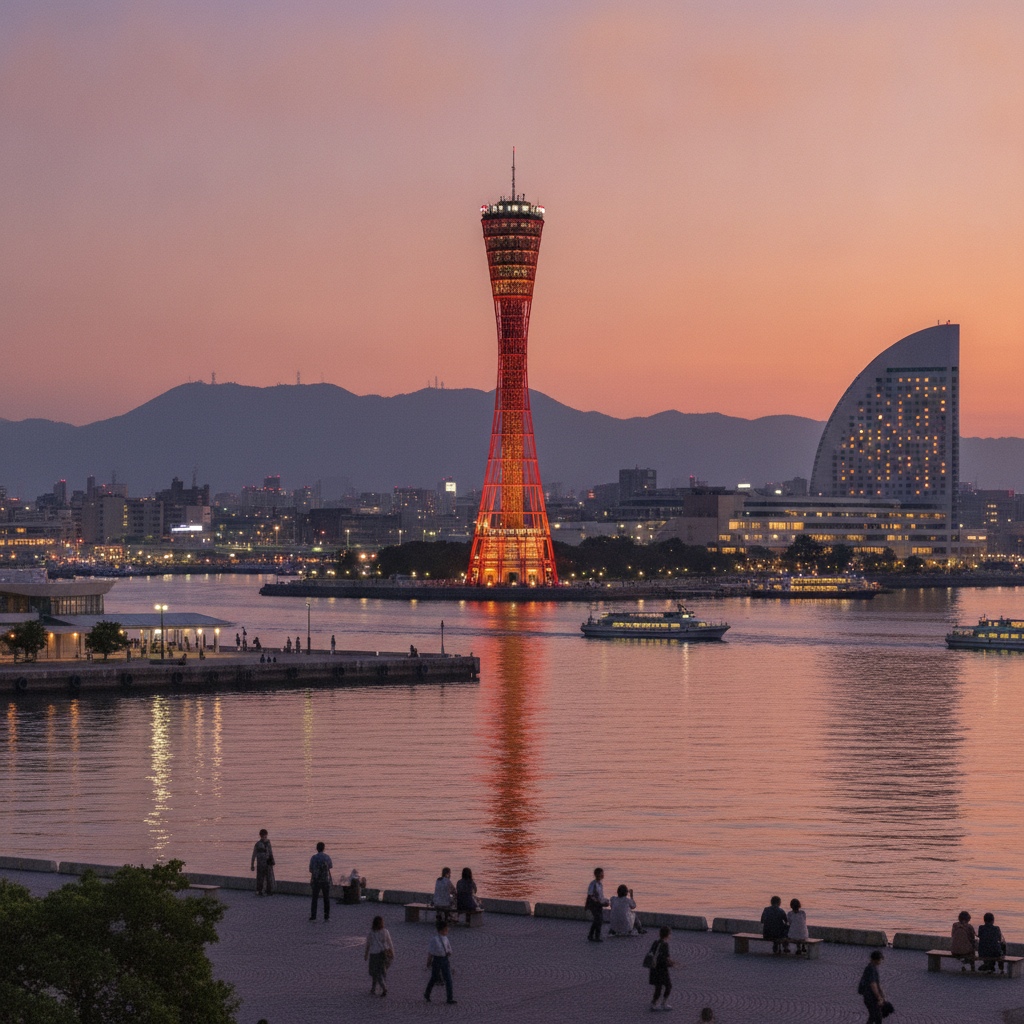
Start at the harbour, a walk south of Sannomiya or one stop on the subway. Kobe Port Tower, the red lattice tower from the 1960s, has an open-air rooftop deck after a recent renovation. The view across the harbour and back to the Rokko mountains is the Kobe geography lesson: the city is a strip of flat land between water and steep hills, which is why it grew as a port and why it sits so photogenically.
In the park below, an earthquake memorial preserves a stretch of quay exactly as it was after the 1995 earthquake, tilted, cracked, lamp posts leaning. It's small and it stops people in their tracks.
Kitano: the foreign residences
Take the subway or walk uphill to Kitano Ijinkan, the hillside district where Western merchants built homes after the port opened in the 1860s. About a dozen are open as museums. The Weathercock House, a red-brick German merchant's house and the district's symbol, has been through a period of seismic renovation, so check its current status before you go. The green-painted Moegi House next door is a reliable second stop with a good interior. The lanes are steep, the cafes are good.
Nankinmachi: Chinatown
Back downhill, southwest of Sannomiya, is Nankinmachi, a compact Chinatown. The reason to come is a steamed pork bun from one of the long-running shops here. There's a queue; it moves. Watch through the window as a worker pinches each bun closed with a rapid twist of the fingers and drops the tray into the steamer, the burst of steam smells of pork, ginger and yeast and rolls out onto the street.
Dinner
By now it's evening and you've walked a good distance. Time for the beef. Whether teppanyaki, where the chef cooks in front of you on a steel plate, the fat rendering with a hiss, the meat seared for barely a minute a side, or sukiyaki or shabu-shabu, a certified restaurant will show you the raw cut on a board before cooking so you can see the marbling for yourself.
The route, on your phone
Sannomiya, harbour, Kitano, Nankinmachi, dinner is a loop with a lot of hill and a lot of choice. Our Kobe Harbor, Kitano & Kobe Beef Food Walk Pamphlet lays it out with walking and transit directions between each stop, which Kitano houses to prioritise, how to read the certificate at a Kobe beef restaurant, and a shortlist of certified places at different price levels. It's $20, offline on your phone. You still have to make the reservation, do that first.
Kobe Harbor, Kitano & Kobe Beef Food Walk Pamphlet
Port Tower, the Kitano foreign residences, Chinatown pork buns and a certified Kobe beef dinner, with directions between each stop.
See the full pamphlet